
Termite Control in Pottstown, PA
- Pest Control Service in Pottstown
- Wood-Destroying Insect (WDI) Inspection for Closings
- Mouse Control
- Rat Control
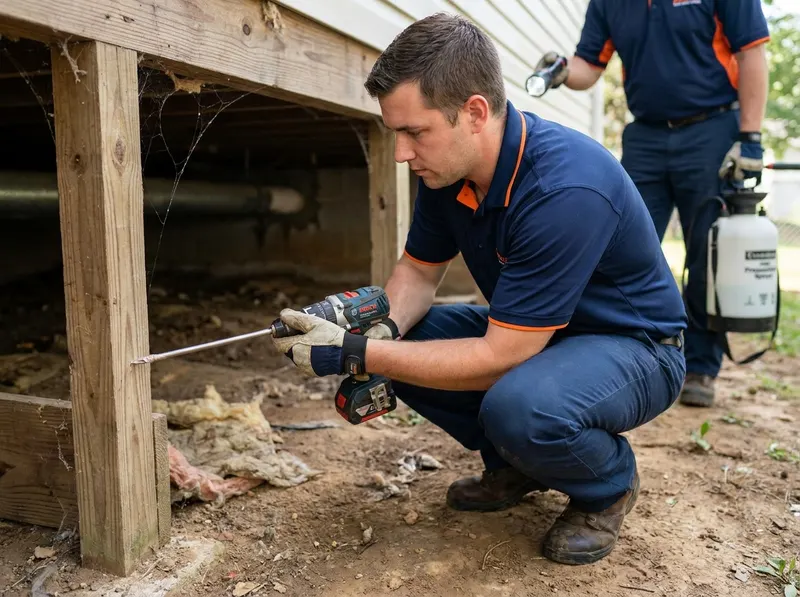
- What's included: a full interior and exterior termite inspection (basement, crawl space, sill plates, porch, garage, exterior grade), photos of every finding, and a written treatment plan naming the entry points before any work begins.
- How fast: inspections are usually scheduled within a few days; most single-family liquid barrier treatments in Pottstown are completed in one visit of roughly three to six hours.
- What it costs: termite work in the Pottstown area typically runs $250 for a small spot treatment up to about $2,500 for a full perimeter barrier on a larger home — ballpark figures, with the exact price confirmed on a free on-site visit.
- What we treat: eastern subterranean termite activity in stone and block basements, slab-on-grade homes, crawl spaces, porch and deck framing, garage sills, sheds, and wood-to-soil contact around the foundation.
- How to book: call (610) 546-0561 and tell us what you saw — mud tubes, discarded wings, hollow-sounding trim, or a closing date you need to meet — and we'll schedule the inspection.
Pottstown's housing stock is exactly what subterranean termites like. The older brick and stone homes off High Street and through the East End and West End often have rubble-stone foundations with mortar joints termites can travel through unseen, plus original wood sill plates sitting close to grade. Row homes share party walls, so activity found in one basement is worth checking next door. Newer slab-built homes in Sanatoga and out toward Kenilworth trade one problem for another: no basement to inspect, so the first sign is often a mud tube behind baseboard or a soft spot in a door frame. Homes near the Manatawny Creek and the Schuylkill corridor — the streets below Memorial Park, the low ground toward Riverfront Park — hold moisture in the soil longer, and consistent soil moisture is what lets a colony forage right up against a foundation year after year.
Most calls come in spring. On the first warm, humid afternoons in March through May, mature colonies release **swarmers** — dark winged insects that pile up on windowsills and around basement light fixtures, then shed their wings. Finding a small heap of identical wings by a Rosedale or Stowe basement window is a strong sign of an established colony under or beside the house, not a passing nuisance. Swarmers are also easy to confuse with flying ants, which is why we identify the insect in front of you rather than quoting over the phone. Off-season, the tells are quieter: pencil-width mud tubes climbing a foundation wall, blistered paint on trim, a bit of hollow give when a screwdriver handle taps a joist near the sill.
The method depends on the house. A **liquid soil barrier** is the workhorse for Pottstown homes with accessible foundations — the soil is trenched and treated around the perimeter, and where a patio, walkway, or attached porch slab blocks access, those areas are drilled and treated below, then patched. It addresses termites coming from the soil around the whole structure. **Bait stations** installed in the ground make more sense when the perimeter is broken up by mature landscaping, hardscape, or a well, when a homeowner wants a lower-disturbance approach, or when the goal is ongoing monitoring on a property that has been hit before. The trade-off is honest: liquid works on contact with treated soil and gets the barrier in place the day we treat; baiting works through the colony's own foraging and takes longer to show results, but leaves in-ground monitors you can check season after season. A **spot treatment** — one garage sill, one shed, one porch column — is appropriate for isolated activity, and we'll say so instead of selling a full perimeter you don't need.
Termites are also a real-estate problem in this market. If a lender, buyer, or attorney is asking for a wood-destroying insect report before a closing on a Ringing Rocks or Pottsgrove Manor–area property, tell us the date when you call and we'll be straight with you about what we can provide and how quickly. The other thing worth saying out loud: treatment stops the termites, but it does not fix the conditions that invited them. Mulch piled against siding, a downspout dumping at the foundation, firewood stacked against a garage wall, wood siding buried in a raised bed — we point out every one of them, with photos, because those are the reasons infestations return. That is the whole point of how we work: **we find how they got in**. And we'll tell you clearly whether follow-up monitoring is a one-time service or an ongoing agreement before you sign anything.
Call (610) 546-0561Termite Control pricing in Pottstown
| Termite inspection with photo findings and written plan (existing homeowner) | free on-site visit |
| Spot treatment, single isolated area (garage sill, shed, porch column) | $250 – $600 |
| Partial perimeter liquid soil treatment (one or two elevations) | $600 – $1,200 |
| Full perimeter liquid barrier, typical Pottstown single-family home | $1,200 – $2,500 |
| Full perimeter liquid barrier, row home or smaller footprint | $700 – $1,500 |
| In-ground bait station system, install plus first-season monitoring | $900 – $1,800 |
| Slab, patio, or walkway drilling and treating (add-on to barrier work) | $250 – $700 |
| Annual re-inspection and monitoring renewal | $250 – $400 |
Exact price confirmed free on-site before any work.
Termite Control — questions, answered
How much does termite treatment cost in Pottstown?
Termite treatment in Pottstown generally ranges from $250 for a small spot treatment to roughly $2,500 for a full perimeter liquid barrier on a larger single-family home. Price depends on the linear footage of foundation, how much of it is blocked by concrete that needs drilling, and whether you choose a liquid barrier or in-ground bait stations. Every figure is a ballpark until we measure the house — the exact price is confirmed in writing on a free on-site visit.
When do termites swarm in Pottstown, PA?
Eastern subterranean termites in the Pottstown area typically swarm on warm, humid days from March through May, often right after rain. Homeowners usually notice the discarded wings before the insects themselves — small piles of matching wings on basement windowsills, near sliding doors, or around light fixtures. A swarm inside the house indicates an established colony at or under the structure and is worth an inspection the same week.
How do I tell termites from flying ants in a Pottstown basement?
Termite swarmers have straight, bead-like antennae, a uniform-width body with no pinched waist, and four wings of equal length; flying ants have elbowed antennae, a narrow waist, and front wings noticeably longer than the back pair. Pottstown basements produce both, especially in older stone-foundation homes in the East End and West End. Save a few specimens or the shed wings in a sandwich bag and we will identify them in front of you rather than guessing over the phone.
Is termite treatment safe around children, pets, and gardens in Pottstown?
Termite treatment in Pottstown is applied to soil and structural wood along the foundation, not sprayed through living space, and products are used strictly per their label directions including re-entry timing. We tell you before we start which areas to keep kids and pets off and for how long, and we work around vegetable beds, wells, and downspout discharge points instead of through them. If you have a specific concern — a raised bed against the foundation, a fish pond, a dog run — say so at the inspection and we will plan the treatment around it.